A homemaker’s focus is on the whole house, ensuring that every room is a healthy and clean sanctuary. You might assume the kitchen’s pollution stays in the kitchen, but in modern, tightly sealed homes, airborne contaminants travel quickly.
Understanding how proper range hood placement protects your entire home’s air is recognizing that the kitchen is the primary pollution source in the house, and effective containment there is the key to clean air everywhere else.
The air in your home is constantly moving. The heat from cooking creates a strong convection current that carries pollutants into the immediate kitchen area. From there, the home’s central air system, drafts, and even the simple movement of people can distribute microscopic contaminants like PM2.5 and NO2 into adjacent living areas, hallways, and bedrooms. This means a poorly placed hood on the ground floor can compromise the air quality on the second floor.
Proper range hood placement acts as a localized, high-power filtration system, preventing these contaminants from ever leaving the kitchen area. The goal is to create a complete capture of the cooking plume, ensuring all of the grease, steam, heat, and airborne toxins are exhausted to the outdoors.
Key elements of proper range hood placement include:
- Maximizing Capture Area: The hood should overhang the cooking surface by a few inches on each side to create a funnel effect. This ensures that the expanding heat plume is fully enclosed, even when there are minor cross-drafts in the kitchen.
- Maintaining Optimal Distance: As discussed, the critical distance (typically 24–30 inches for gas) must be maintained. This height ensures the suction is strong enough to grab the hot, fast-moving plume before it loses momentum and disperses.
- Venting Outdoors: A range hood must be ducted to the outside. Recirculating (ductless) hoods only filter grease and some odors with charcoal. They do not remove the harmful particulate matter or gases like NO2 from the home, and therefore do not provide true protection.
When done correctly, proper range hood placement means that high-heat cooking, which can temporarily spike PM2.5 levels to magnitudes higher than outdoor smog, is contained and removed. This single appliance’s effective installation is the frontline defense for your entire home.
The best way to verify this effectiveness is by measuring the air quality in the adjoining rooms. If you run the hood while cooking and the PM2.5 levels in the living room remain stable and low, you have successfully contained the pollution.
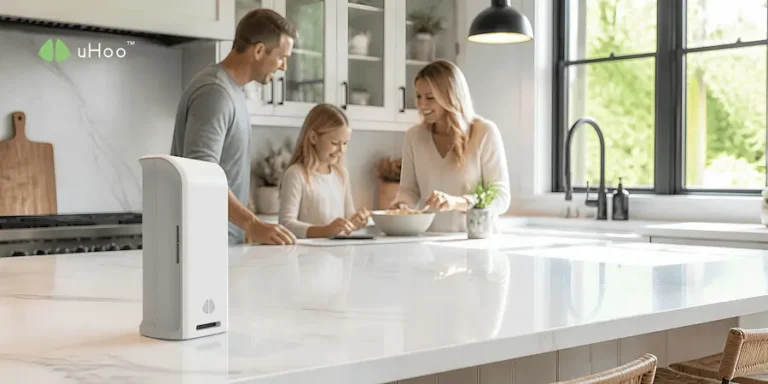
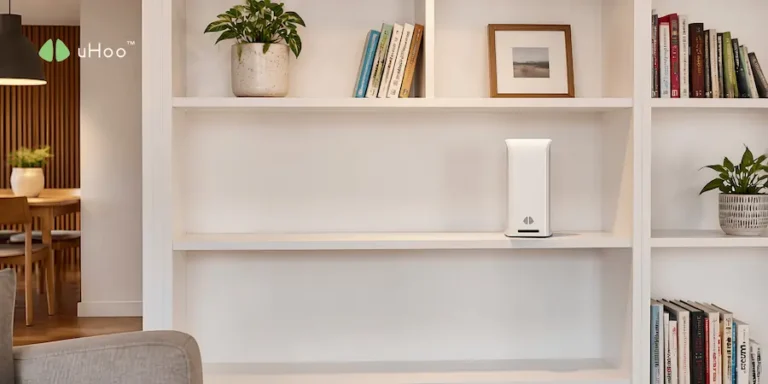
uHoo gives you the ability to monitor the air quality in multiple rooms, confirming that your kitchen efforts truly protect the whole home’s environment. The data from uHoo is what validates that your meticulously chosen and placed range hood is, in fact, protecting your family’s air quality everywhere.