
If you’re looking for the best indoor air quality monitor for CO2 and PM2.5, focus on more than whether a device simply lists these two sensors. A useful monitor should measure them continuously, provide reliable readings, show historical trends, and alert you when conditions change.
CO2 and PM2.5 tell you two very different things about your indoor environment. CO2 can help you understand ventilation in occupied spaces, while PM2.5 reveals fine particle pollution from sources such as cooking, smoke, combustion, and outdoor air.
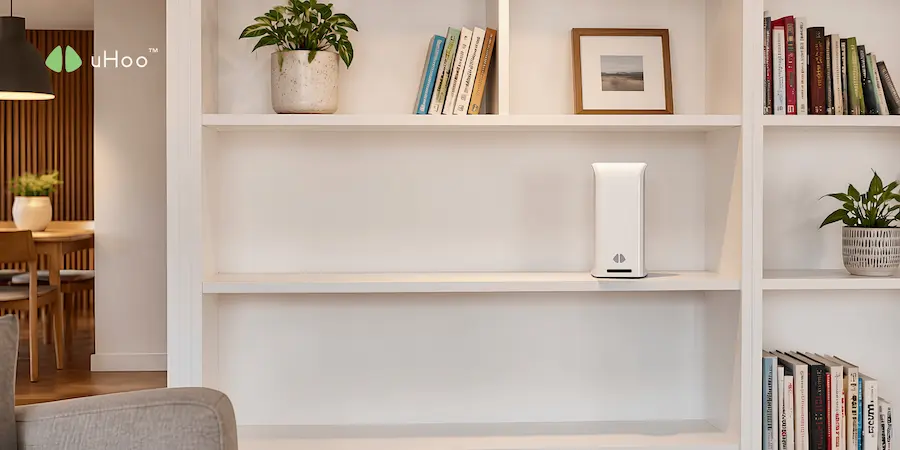
For households that want both measurements plus a broader picture of their air, uHoo Caeli combines CO2 and PM2.5 monitoring with seven additional indoor environmental parameters in one device.
Why Should You Monitor Both CO2 and PM2.5?
Choosing a monitor that measures both is useful because good CO2 levels don’t necessarily mean low particle pollution, and low PM2.5 doesn’t necessarily mean a room is well ventilated.
The two measurements answer different questions.
CO2 asks: Is ventilation keeping up with the people occupying this room?
PM2.5 asks: How much fine particulate pollution is currently in the air?
Monitoring both provides significantly more context than relying on a general air quality score.
The U.S. EPA notes that consumer air pollution monitors may measure pollutants such as particulate matter and carbon dioxide, as well as environmental conditions including temperature and humidity.
What Does CO2 Tell You About Indoor Air?
People naturally release carbon dioxide when they breathe. In occupied indoor spaces, CO2 can therefore increase when ventilation is limited.
Imagine working for several hours in a small home office with the door and windows closed. The room may look perfectly normal, but CO2 can gradually rise.
Continuous monitoring helps reveal these patterns.
You might discover that CO2:
- Rises overnight in your bedroom
- Increases during meetings
- Climbs when several people are in the living room
- Falls after improving ventilation
- Regularly reaches its highest level at a certain time
Instead of relying on whether a room “feels stuffy,” you have actual measurements showing how conditions change.
What Does PM2.5 Tell You?
PM2.5 refers to fine particulate matter measuring 2.5 micrometers or smaller.
These tiny particles can come from several indoor and outdoor sources.
At home, PM2.5 can change because of:
- Cooking
- Smoke
- Combustion
- Candles
- Outdoor traffic pollution
- Wildfire smoke entering indoors
- Other particle-generating activities
PM2.5 is particularly important because you cannot reliably determine particle concentrations by looking at the room.
A monitor makes these invisible changes visible.
What Makes a Good CO2 and PM2.5 Monitor?
If you’re comparing indoor air quality monitors, don’t choose based only on the presence of CO2 and PM2.5 sensors.
Consider the complete monitoring experience.
1. Continuous Measurements
Indoor air changes throughout the day, so your monitor should collect data continuously.
An occasional reading might miss a PM2.5 spike while you’re cooking or a gradual CO2 increase while you’re sleeping.
2. Reliable Sensor Specifications
Check whether the manufacturer publishes information about sensor range, resolution, and accuracy.
This gives you a better understanding of what the readings represent.
3. Historical Data
Real-time information tells you what’s happening now.
Historical data tells you what keeps happening.
That’s often more useful because it helps identify recurring patterns.
4. Alerts
You shouldn’t need to constantly open an app and check your readings.
A smart air quality monitor should alert you when important conditions change.
5. Multiple Parameters
CO2 and PM2.5 are valuable, but neither provides a complete picture of indoor air quality.
Monitoring humidity, VOCs, temperature, and other pollutants alongside them can provide additional context.
Why uHoo Caeli Goes Beyond CO2 and PM2.5
uHoo Caeli is designed for households that want a comprehensive view rather than separate monitors for individual pollutants.
Caeli measures nine indoor environmental parameters:
- Carbon dioxide (CO2)
- PM2.5
- Volatile Organic Compounds (VOCs)
- Relative humidity
- Temperature
- Air pressure
- Carbon monoxide (CO)
- Nitrogen dioxide (NO2)
- Ozone (O3)
The device uses dedicated sensors and a built-in mini fan for active air sampling, with readings refreshed every minute.
That broader measurement range matters because indoor air problems often overlap.
For example, you might have acceptable PM2.5 but elevated CO2 in a closed bedroom. Another day, CO2 may be low while cooking causes PM2.5 to rise.
One overall “air quality” number may not explain those differences. Individual measurements can.
How Accurate Are uHoo Caeli’s CO2 and PM2.5 Sensors?
Published specifications are worth checking when comparing air quality monitors.
According to uHoo’s current technical specifications, Caeli’s CO2 sensor has a measurement range of 400 to 10,000 ppm, a resolution of 1 ppm, and stated accuracy of ±40 ppm plus 4% of the actual reading.
Its PM2.5 sensor covers 0 to 1,000 µg/m³, with 1 µg/m³ resolution. uHoo states an accuracy of ±10 µg/m³ between 0 and 100 µg/m³ and ±10% above 100 µg/m³.
These published specifications make it easier to evaluate the device based on more than marketing claims.
Real-Time Alerts Make Monitoring More Useful
Seeing an elevated reading is useful. Knowing what to do next is better.
uHoo’s Sense plan, for example, provides real-time monitoring across all nine parameters along with instant alerts and plain-language guidance. uHoo gives examples such as notifying users when bedroom CO2 rises or when PM2.5 spikes in the kitchen.
This turns monitoring into a practical feedback loop:
Measure → Alert → Act → Check the result.
If PM2.5 rises during cooking, you might increase kitchen exhaust ventilation and watch whether readings improve.
If CO2 consistently rises in your home office, you can test ventilation changes and compare the results.
What About VOCs and Humidity?
If you’re already investing in a CO2 and PM2.5 monitor, it makes sense to consider other parameters that provide context.
VOCs can change because of cleaning products, furniture, finishes, sprays, and other household sources.
Humidity helps you understand moisture conditions and can be particularly important for homes concerned about mold.
Monitoring these alongside CO2 and PM2.5 creates a more complete view of your environment.
uHoo Caeli includes both VOC and relative humidity monitoring in addition to its CO2 and PM2.5 sensors.
Can Your Air Monitor Work With Your Smart Home?
Another factor to consider is what happens after your monitor detects a problem.
Caeli supports Matter, Apple Home, Google Home, Amazon Alexa, Samsung SmartThings, and Home Assistant. uHoo’s Command plan adds air-triggered smart home automation, allowing compatible devices to respond based on air conditions.
For example, air quality data can become part of a broader smart-home setup rather than existing only as numbers inside an app.
Who Should Consider a CO2 and PM2.5 Monitor?
Monitoring both parameters can be particularly useful for:
- People working from home
- Families with children
- Apartment residents
- Homes near busy roads
- Households affected by wildfire smoke
- People who cook frequently
- Bedrooms with limited ventilation
- Allergy-conscious households
- Smart home users
Even homes that appear clean can experience significant changes in invisible environmental conditions.
The Bottom Line
The best indoor air quality monitor for CO2 and PM2.5 should do more than display two numbers.
Look for continuous monitoring, transparent sensor specifications, historical data, useful alerts, and measurements that provide context around CO2 and particle pollution.
For households that want comprehensive monitoring, uHoo Caeli combines CO2 and PM2.5 with VOCs, humidity, temperature, CO, NO2, ozone, and air pressure. It updates readings every minute and provides historical monitoring and alerts through uHoo’s home platform.
Instead of guessing whether your air has changed, you can see what’s happening and make informed decisions about what to do next.
Frequently Asked Questions
What is the best air quality monitor for CO2 and PM2.5?
Look for a monitor with dedicated CO2 and PM2.5 sensors, continuous readings, published accuracy specifications, historical data, and alerts. Multi-parameter monitors can provide additional context by tracking VOCs, humidity, temperature, and other pollutants.
Does uHoo Caeli measure both CO2 and PM2.5?
Yes. uHoo Caeli continuously measures both CO2 and PM2.5 along with seven additional environmental parameters.
Is CO2 the same as air pollution?
No. Indoor CO2 is commonly used to understand occupancy-related ventilation conditions. PM2.5, VOCs, CO, NO2, and ozone represent different aspects of indoor air quality.
Is PM2.5 monitoring important at home?
Yes. PM2.5 can change because of cooking, smoke, combustion, and outdoor pollution entering your home. Continuous monitoring helps reveal when these changes occur.
Should I monitor CO2 or PM2.5?
Ideally, monitor both if you want a broader understanding of indoor air. CO2 provides useful information about ventilation in occupied rooms, while PM2.5 measures fine particle pollution.
How often does uHoo Caeli update its readings?
uHoo Caeli refreshes its environmental readings every minute.