
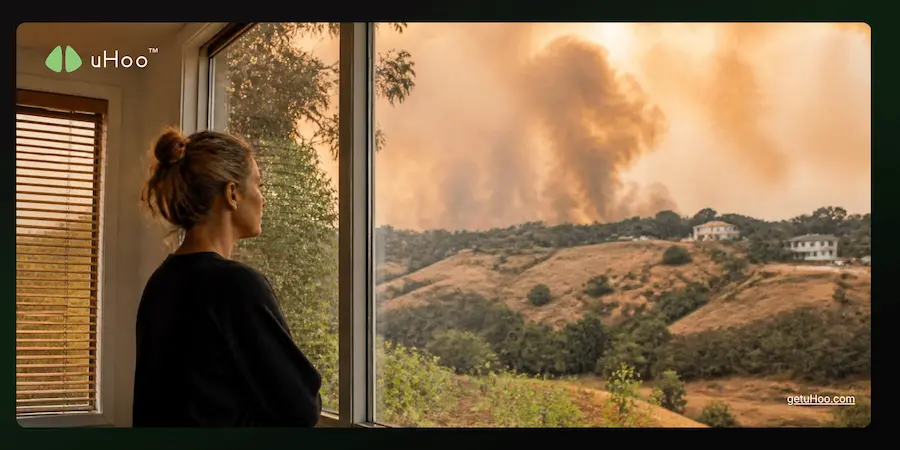
Wildfires are often associated with smoky skies, reduced visibility, and poor outdoor air quality. However, one of the biggest misconceptions is that staying indoors completely protects you from wildfire smoke.
The reality is that wildfire smoke can significantly affect the air inside your home, office, school, or commercial building. Fine particles and gases can enter through ventilation systems, doors, windows, and small openings in the building envelope, changing your indoor environment without you realizing it.
Understanding how wildfire smoke affects indoor air quality can help you take steps to create a healthier indoor space.
Wildfire Smoke Does More Than Reduce Visibility
Wildfire smoke is a complex mixture of gases and airborne particles created when vegetation, buildings, and other materials burn.
Among the pollutants commonly found in wildfire smoke are:
- Fine particulate matter (PM2.5)
- Carbon monoxide
- Volatile organic compounds (VOCs)
- Nitrogen dioxide (NO₂)
- Ozone-forming pollutants
Many of these pollutants are invisible, meaning your indoor air may be unhealthy even if you cannot smell or see smoke inside your home.
Why Indoor Air Quality Changes During Wildfires
Your home naturally exchanges air with the outdoors.
During a wildfire event, smoke can enter through:
- HVAC systems
- Open doors and windows
- Air leaks around doors and windows
- Exhaust fans
- Attics and crawl spaces
Once inside, smoke particles can circulate throughout the building and remain suspended in the air for hours.
Indoor activities such as cooking, cleaning, or burning candles may also add pollutants, making indoor air quality even worse during wildfire events.
The Most Important Air Quality Indicators During Wildfires
Monitoring your indoor environment helps you understand how wildfire smoke is affecting your space.
PM2.5
PM2.5 is the primary pollutant associated with wildfire smoke.
A sudden increase in PM2.5 often indicates that smoke has entered your indoor environment.
Volatile Organic Compounds
Wildfire smoke contains numerous VOCs. Indoor products such as paints, cleaning supplies, furniture, and cooking can contribute additional VOCs, increasing the overall pollution level.
Carbon Dioxide
People often keep windows and doors closed during wildfire events.
While this reduces smoke infiltration, it may also reduce ventilation and cause indoor carbon dioxide levels to rise.
Monitoring both PM2.5 and carbon dioxide helps maintain a balance between cleaner air and adequate ventilation.
Temperature and Humidity
Temperature and humidity influence indoor comfort and can affect how efficiently HVAC systems and air filtration operate.
Maintaining stable indoor conditions supports overall indoor environmental quality during extended smoke events.
Why Outdoor Air Quality Reports Are Not Enough
Many people rely on local air quality reports during wildfire season.
While these reports are valuable, they only describe outdoor conditions across a broader area.
Indoor air quality varies from one building to another depending on:
- Building age
- Air sealing
- HVAC performance
- Filter quality
- Occupancy
- Frequency of opening doors and windows
Two neighboring homes may have very different indoor air quality even though they share the same outdoor air quality index.
How Real-Time Monitoring Helps
Without continuous monitoring, it can be difficult to know when wildfire smoke begins affecting your indoor environment.
The uHoo Caeli continuously measures important indoor environmental factors, allowing you to see changes as they happen.
Instead of guessing whether smoke has entered your home, you can respond using real-time data.
This allows you to:
- Turn on air purifiers when particle levels rise
- Adjust ventilation when appropriate
- Evaluate whether HVAC filtration is working effectively
- Reduce indoor pollution sources
- Track improvements after taking action
Simple Ways to Improve Indoor Air During Wildfires
If wildfire smoke is affecting your area, consider these practical steps.
- Keep windows and exterior doors closed whenever outdoor air quality is poor.
- Use compatible high-efficiency HVAC filters.
- Operate HEPA air purifiers in occupied rooms.
- Avoid burning candles or fireplaces.
- Limit cooking methods that produce smoke or grease particles.
- Reduce unnecessary indoor chemical use.
- Monitor indoor air quality continuously.
Combining these actions with real-time monitoring provides a more complete strategy for reducing smoke exposure indoors.
How uHoo Helps You Stay Informed
The uHoo Caeli tracks multiple indoor environmental factors, including:
- PM2.5
- Carbon dioxide
- Volatile organic compounds
- Carbon monoxide
- Nitrogen dioxide
- Ozone
- Temperature
- Humidity
- Air pressure
- Airborne mold risk
These measurements help homeowners, businesses, schools, and facility managers understand how wildfire smoke affects their indoor environments and whether mitigation efforts are working.
Instead of relying solely on regional air quality reports, you gain visibility into the air you actually breathe.
Healthy Indoor Air Matters More Than Ever
Wildfires are becoming a more frequent part of life across many regions. Even when fires are hundreds of miles away, smoke can affect the quality of the air inside your home.
By understanding how wildfire smoke changes indoor air quality and monitoring your indoor environment, you can make informed decisions that help reduce exposure and create healthier spaces.
Learn how the uHoo Caeli helps you monitor your indoor air in real time, giving you greater confidence during wildfire season and throughout the year.