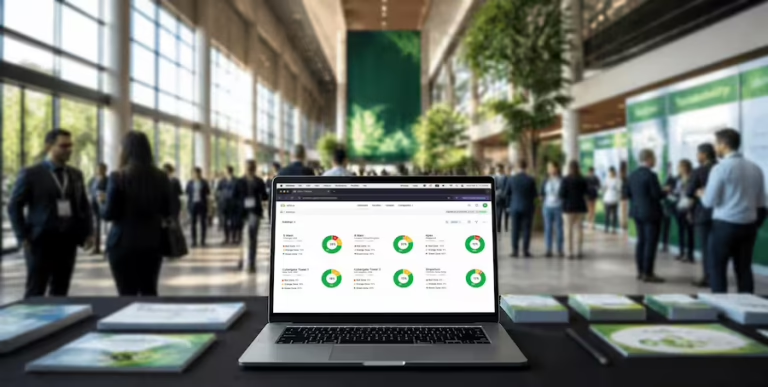

When air quality becomes a workplace concern
Indoor air quality plays a significant role in employee comfort and performance. Yet when concerns arise, validating them can be challenging.
IAQ complaints often begin with subjective experiences. Employees may report headaches, fatigue, or a sense of stuffiness, but these symptoms are difficult to attribute to a specific environmental cause without measurable evidence.
This creates a gap between perception and proof.
The subjectivity of employee reports
Employee reports are essential signals that something may be wrong. However, they vary widely in timing, location, and severity.
One employee may feel discomfort in a meeting room, while another may not notice any issue in the same space.
Without data, facility and workplace teams must rely on anecdotal information, which can complicate response strategies and delay resolution.
Environmental factors are invisible
Air quality concerns are difficult to validate because most pollutants are not detectable through sight or smell.
Elevated carbon dioxide, volatile organic compounds, and particulate levels may fluctuate throughout the day without obvious indicators.
This invisibility makes IAQ complaints harder to investigate using observation alone.
Timing and fluctuation challenges
Indoor air conditions change based on occupancy, ventilation performance, and daily activity.
For example
• CO2 may peak during high occupancy meetings
• VOC levels may rise after cleaning
• Ventilation gaps may occur during system transitions
If testing does not occur at the right moment, the issue may go undetected.
Operational and reputational implications
Unresolved IAQ complaints can affect more than comfort. They may influence employee trust, workplace satisfaction, and organizational reputation.
When concerns cannot be validated, it becomes difficult to determine whether infrastructure upgrades, policy changes, or communication efforts are needed.
Data provides the clarity required to act confidently.
The role of office air monitoring
Office air monitoring introduces objective measurement into IAQ management.
Continuous monitoring allows organizations to
• Correlate employee reports with environmental data
• Identify recurring air quality patterns
• Detect ventilation or pollutant anomalies
• Provide transparent reporting to stakeholders
This evidence-based approach bridges the gap between perception and operational insight.
Turning complaints into actionable intelligence
Rather than viewing IAQ complaints as isolated incidents, organizations can treat them as data entry points for deeper environmental evaluation.
Solutions like uHoo Aura provide continuous office air monitoring across multiple air quality parameters, enabling facility teams to validate concerns with real-time evidence.
With measurable insight, businesses can respond more effectively, build employee confidence, and create workplaces grounded in transparency, accountability, and healthier indoor air management.