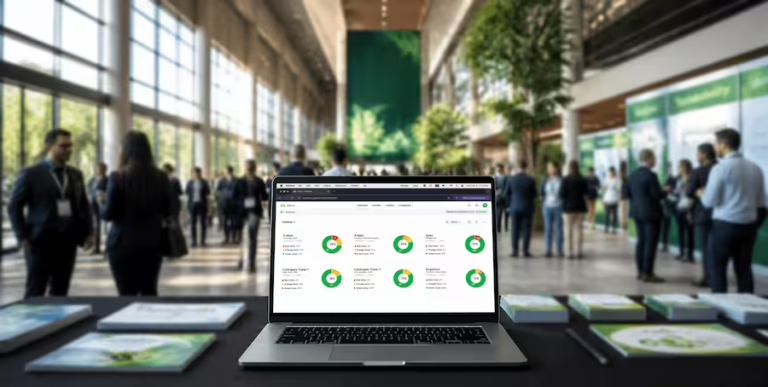

Risk management in modern buildings has evolved beyond structural integrity and security systems. Today, indoor environmental conditions play a critical role in identifying and mitigating operational risks.
By leveraging IAQ risk management strategies, organizations can use environmental data to detect issues early, reduce uncertainty, and strengthen overall facility resilience.
Invisible risks are often the hardest to manage
Unlike physical hazards, indoor air quality issues are not always visible.
Elevated CO2 levels, increasing VOC concentrations, or poor airflow conditions may develop gradually without immediate warning signs. These hidden risks can:
- Affect employee comfort and performance
- Contribute to health-related complaints
- Lead to long-term building issues
Without measurable data, these risks are difficult to detect and even harder to validate.
Reactive approaches increase exposure
Many organizations address IAQ concerns only after problems are reported.
This reactive approach can result in:
- Delayed response to environmental issues
- Increased operational disruption
- Higher costs associated with remediation
By the time action is taken, the impact may already be significant.
Data introduces early risk detection
Continuous monitoring provides real-time insight into indoor conditions, allowing organizations to detect changes before they escalate.
With environmental data, facility teams can:
- Identify rising CO2 levels in high-occupancy areas
- Detect abnormal VOC spikes linked to indoor activities
- Monitor airflow and ventilation effectiveness
- Track humidity conditions that may increase mold risk
This proactive visibility reduces uncertainty and supports faster, more informed decision-making.
Supporting compliance and accountability
Environmental data also plays a key role in compliance and reporting.
Organizations can use IAQ data to:
- Demonstrate adherence to workplace safety standards
- Provide documentation during audits or inspections
- Support internal risk assessments
This strengthens accountability and transparency across building operations.
From monitoring to risk intelligence
Solutions like uHoo Aura enable organizations to transform environmental data into actionable risk intelligence.
By continuously tracking multiple IAQ parameters, businesses can identify potential issues earlier, reduce exposure to environmental risks, and maintain healthier, more stable indoor environments.
In today’s complex building landscape, air quality data is no longer optional—it is a critical component of effective risk management.