
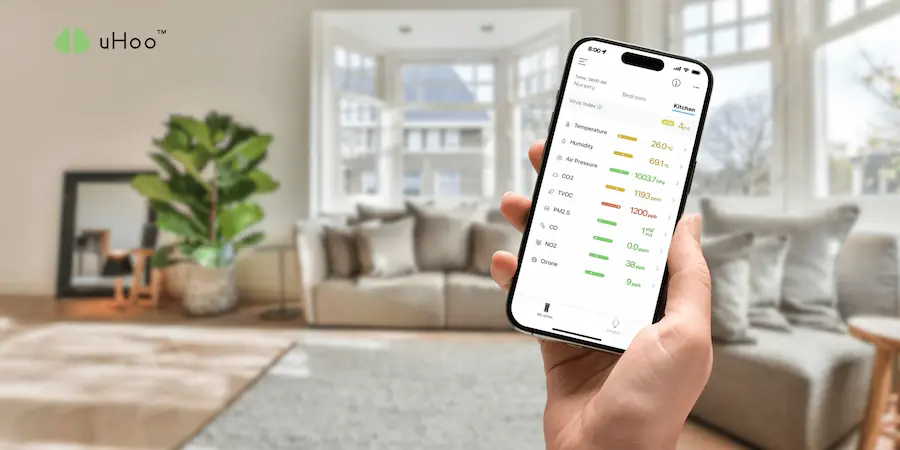
Congratulations! You’ve taken the first step toward a healthier home by getting a uHoo air quality monitor. You know your home’s air is important, but if you’re a beginner, all the numbers, acronyms, and colorful graphs might feel a little overwhelming.
The good news is that uHoo is designed for you. This guide will simplify the key metrics and show you exactly how to understand your air so you can start making immediate, positive changes.
The Big Three: Where to Focus First
To start, you don’t need to be an expert on all nine sensors. Focus on the three parameters that have the most immediate and tangible impact on your comfort and health:
| Acronym | What It Is | What High Levels Mean | The Simple Fix |
| PM2.5 | Particulate Matter (Fine dust, smoke, pet dander, pollen) | You are inhaling tiny particles that irritate your lungs, trigger allergies, and cause congestion. | Run a HEPA air purifier or vacuum; check and change your HVAC filter. |
| VOCs | Volatile Organic Compounds (Chemical gases from products) | Your air has chemical irritants from cleaning sprays, new paint, or strong air fresheners that can cause headaches. | Open windows for ventilation; switch to non-toxic, unscented cleaning products. |
| CO2 | Carbon Dioxide (A measure of fresh air/ventilation) | The room is stale; you might feel sleepy, groggy, or unfocused (the ‘stuffy room’ feeling). | Open a window or door for a few minutes to bring in fresh air. |
uHoo’s simple color-coding (Green, Yellow, Red) is your beginner shortcut. If you see a metric turn yellow or red, focus on that one first and use the simple tips in the app to address it.
Your Air as a Historical Record
Once you get comfortable with the Big Three, the next step to understand your air is to look at the historical data in the uHoo app. This is where the real power lies because it connects your everyday life to your air quality.
Look for patterns over a few days or a week:
- Do your VOCs spike every Tuesday afternoon? That might be your routine cleaning time.
Insight: You’ve identified the source.
- Is your PM2.5 always highest between 6 PM and 8 PM? That’s likely dinner time.
Insight: You need to use your kitchen exhaust fan more effectively.
- Does your CO2 level gradually rise every night in the bedroom? That’s you and your family sleeping with a closed door.
Insight: You may need a small gap under the door or an open window crack for better airflow.
This historical data helps you pinpoint not just what the problem is, but when and why it’s happening, allowing you to make smarter, more preventative changes.
Turning Knowledge into a Healthy Routine
The goal of uHoo is to turn you into a “smart breather.” By following the easy-to-read data and the actionable tips, you’ll naturally develop a healthier routine:
- You’ll start running your air purifier before you see the PM2.5 spike from wildfire smoke.
- You’ll open a window during that 3 PM meeting when the CO2 is starting to climb.
- You’ll swap out that chemical spray for a natural cleaner that doesn’t cause a tVOC alarm.
Learning to understand your air with uHoo isn’t about becoming a scientist; it’s about using simple, powerful data to make daily decisions that dramatically improve your comfort, focus, and long-term health. It’s the ultimate step toward turning your house into the healthiest home it can be.