
Mold isn’t just an ugly stain. It’s a significant health concern that contributes to allergies, asthma flare-ups, and other respiratory issues. Mold spores are air-polluting agents, and the key to stopping them from proliferating in your home is catching the underlying moisture problem early. This is where an Infrared (IR) thermometer becomes an indispensable tool for every conscientious homeowner looking to preemptively tackle mold hazards.
The magic of IR technology lies in its ability to detect the thermal footprint of moisture. Water has a higher heat capacity than most common building materials. More importantly, as that water evaporates, it causes a cooling effect, known as evaporative cooling. This means that a water-saturated area within a wall, even if the surface feels dry to the touch, will be measurably cooler than the surrounding dry material.
An IR thermometer translates this difference in infrared energy radiation into a temperature reading. A lower-than-expected temperature reading is essentially a non-contact signal that moisture is likely present. This is a crucial diagnostic step because mold can start growing within 24–48 hours of water exposure, long before it becomes visible or produces that tell-tale musty odor.
For a beginner, a systematic scan is the most effective approach:
- Calibrate Your Eye: Before scanning suspected areas, point the IR thermometer at a surface you know is dry and healthy (a wall in the center of a well-ventilated room, for instance) to establish your baseline temperature.
- Scan Problem Zones: Direct the laser-pointer of the IR thermometer across surfaces that are prone to leaks or condensation. These include the corners of rooms, the base of walls, ceilings below bathrooms, and areas around exterior door and window frames.
- Look for the Cold Signal: Watch the temperature display closely. A sudden and significant drop—say, 5 to 10 degrees Fahrenheit—compared to your baseline reading indicates a potential mold hazard hot spot where moisture is trapped. The cold spot is the sign of moisture; the moisture is the condition for mold.
- Verify the Anomaly: Once a cold spot is identified, this is the time to confirm the presence of moisture with a dedicated moisture meter, or to follow up with a deeper investigation to find the water source.
While an IR thermometer is great for spot-checking a suspected area, comprehensive indoor air quality management requires continuous, all-encompassing monitoring. This is where a smart air quality monitor like uHoo provides the necessary long-term perspective.
IR technology helps you locate the source of the problem, but a uHoo monitor tells you the impact on the air you breathe. By monitoring multiple parameters like humidity, temperature, and VOCs, the uHoo device ensures that your entire home environment remains hostile to mold growth.
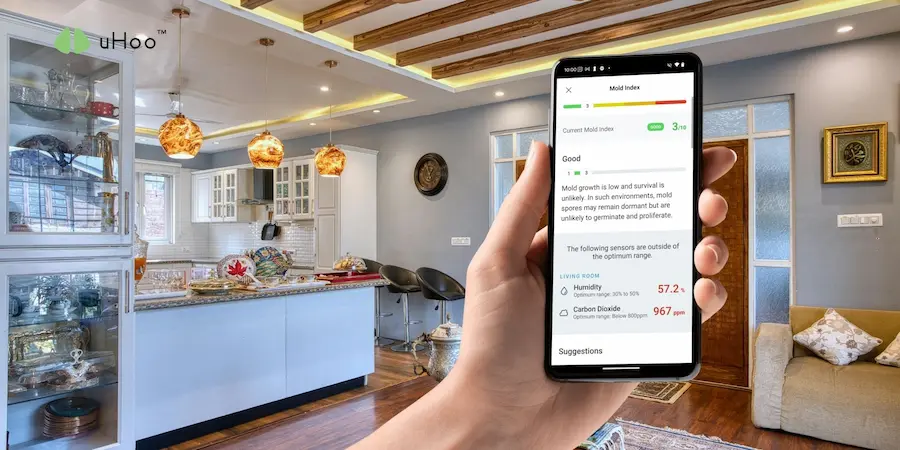
To transform this knowledge into actionable insights, uHoo offers its proprietary uHoo Mold Index. Think of the IR thermometer as a flashlight that helps you find the wet spot. The uHoo Mold Index is the weather forecast for mold growth across your entire home.
It’s a dynamic, simple-to-understand score that processes continuous data from your uHoo sensors to predict the likelihood of mold proliferation, empowering you to adjust ventilation or dehumidification before the hazard takes root, far beyond what a simple spot temperature check can achieve.