
One of the biggest challenges in indoor air quality is dealing with mold that grows hidden from view, often inside your walls. By the time you see the visible signs (the black spots or the musty smell) the mold has already been growing for some time.
The secret to a truly healthy home is to stop mold before it takes hold. An infrared (IR) thermometer is an affordable and non-invasive tool that helps you do exactly that by detecting the single most crucial factor for mold growth: hidden moisture.
The Principle of Early Detection
To understand how to stop mold using an IR thermometer, you must first understand why mold starts. Mold spores are ubiquitous; they are always in the air. They only become a problem when they land on a surface that is both a food source (like wood or drywall) and, crucially, wet.
By identifying the presence of moisture through temperature difference, the IR thermometer gives you the power of early detection, allowing you to address the water source before mold gets its foothold.
The surface of a wet material loses heat faster through evaporation. This process of evaporative cooling means a damp spot behind a wall will radiate less heat and, therefore, appear cooler on your IR thermometer’s display. This temperature anomaly is your cue to investigate.
Your Proactive Scan Strategy
You don’t need to tear down walls to find hidden moisture; you just need a systematic approach:
- Target High-Risk Areas: Focus your IR scan on spots most likely to harbor trapped moisture. This includes:
- Areas where plumbing runs (behind washing machines, under sinks, near showers).
- Below-grade walls (basements and crawl spaces).
- Around any pipe penetrations, windows, and doors that lead to the exterior.
- Establish a Thermal Baseline: Scan a known dry, interior wall to get your baseline temperature reading.
- Search for Cold Zones: As you scan, look for spots that are 5 to 10 degrees Fahrenheit cooler than your baseline. Mark these spots—they are prime candidates for hidden moisture and the beginning of mold growth.
- Confirm the Source: Once a cold spot is found, your immediate next step is to figure out the source of the water (e.g., a small leak, condensation, or water intrusion from outside). Fixing the source is the only way to permanently stop mold.
Integrating Tools for a Complete Solution
An IR thermometer provides the localized, physical check you need. It tells you where the moisture is. However, a comprehensive air quality monitor like uHoo tells you the environmental conditions that favor mold growth across your entire home.
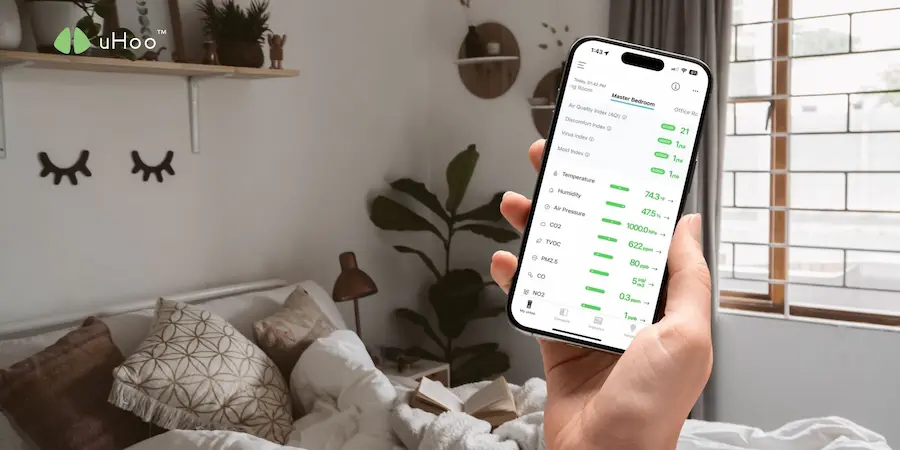
By continuously monitoring factors like temperature and relative humidity, the uHoo monitor alerts you when the overall environment becomes conducive to mold. This allows you to deploy your IR thermometer in a targeted manner.
To truly stop mold growth in its tracks, uHoo provides an indispensable, preventative metric: the uHoo Mold Index. While your IR thermometer helps you physically detect a localized cold spot of moisture, the uHoo Mold Index is a proprietary score that evaluates the total environment reported by your sensor to predict the overall risk for mold growth throughout your home.
A rising score on this index is a crucial early warning signal that your home’s conditions (humidity, temperature, etc.) are aligning to favor mold, prompting you to pick up your IR thermometer and find the exact source before the growth process even begins.