
Improving indoor air quality (IAQ) and effectively battling mold can seem like a complex, expensive endeavor, but it often starts with a single, simple tool to fight mold: the infrared (IR) thermometer.
This non-contact device is a powerful diagnostic instrument that allows homeowners to find the root cause of most mold problems, hidden moisture, before it impacts the health of their home and family.
Why Simple is Smart: The Power of Non-Contact Diagnostics
Mold is a tenacious opponent, but it has one major vulnerability: its reliance on water. Mold thrives on damp materials, and when it grows, it releases spores that drastically reduce air quality. The IR thermometer is a simple tool to fight mold because it allows you to detect the precursor to mold growth, the moisture, without having to drill, cut, or visually inspect behind walls.
By measuring the surface temperature, the IR thermometer exploits the evaporative cooling effect. Wet spots are colder than dry spots. When you aim the laser-guided thermometer at a wall and see a localized temperature dip, you are seeing the thermal signature of moisture. This makes the hunt for hidden leaks or excessive condensation as easy as a point-and-read exercise.
How to Use This Simple Tool to Fight Mold
A beginner can master the use of an IR thermometer with minimal practice:
- Establish Normality: Scan a few healthy, dry walls in the center of a room to determine the typical temperature of your building materials. This is your thermal baseline.
- Target and Search: Systematically scan the perimeter of rooms, especially the ceiling-to-wall and wall-to-floor junctions. Move the thermometer slowly across the surface, watching for any temperature drop.
- Identify the Threat: A significant drop in temperature (e.g., 4-10°F cooler) is the thermal cue for a moisture-saturated area. This is where mold is most likely to start growing, making this spot your priority for repair.
- Confirming Success: After fixing the moisture source and beginning the drying process, re-scan the area. Once the temperature of the formerly cold spot normalizes and matches the dry wall baseline, you have successfully eliminated the moisture source and greatly reduced the mold risk.
Creating a Proactive IAQ Strategy
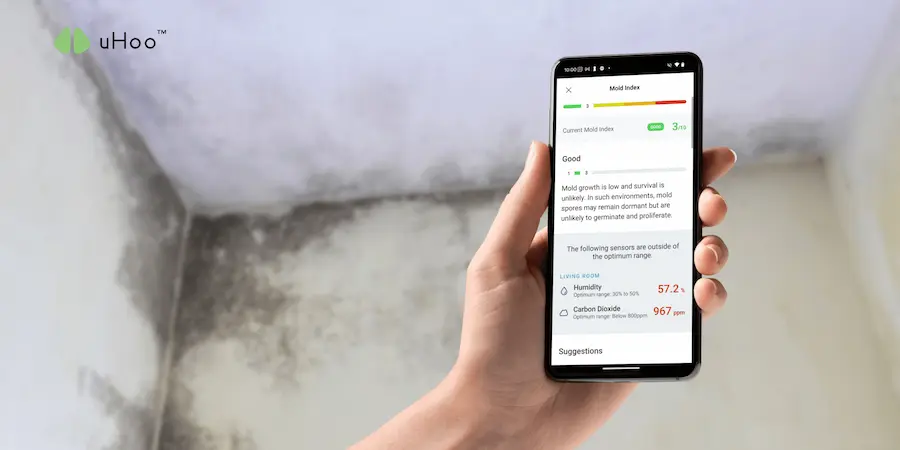
Using an IR thermometer is an excellent tactic for locating specific problem areas. However, a complete IAQ strategy requires continuous monitoring. A smart air quality monitor, such as uHoo, provides this necessary oversight. It monitors the overall environmental conditions—like humidity and temperature—that contribute to mold growth. An alert from uHoo about high humidity can prompt you to grab your IR thermometer and search for the specific cold spot that is causing the problem.
The final, and perhaps most important, piece of the puzzle is the uHoo Mold Index. While your IR thermometer is a simple tool to fight mold by finding the localized moisture, the uHoo Mold Index is a proprietary, real-time index that provides a holistic and predictive risk assessment for your entire home.
It processes the continuous stream of environmental data from your uHoo monitor to give you a single, clear score, essentially acting as an advanced, 24/7 weather forecast for mold. This index empowers you to adjust your home’s conditions or conduct an IR scan long before any visible or olfactory signs of mold appear, keeping your air quality pristine.