
The key to maintaining pristine indoor air quality (IAQ) is proactive prevention. An unexpected rise in airborne pollutants, especially mold spores, constitutes an air quality crisis, and this crisis is almost always preceded by moisture. IR thermometers are simple, yet powerful, diagnostic tools that can help you predict your next air quality crisis by finding the hidden moisture before mold begins to proliferate.
Understanding the Predictive Power of IR Thermometers
IR thermometers do not detect mold or air quality directly. Instead, they detect the conditions that lead to the crisis: hidden water. As explained in previous articles, water within a material cools the surface through evaporative cooling. A drop in surface temperature, therefore, is a thermal clue that moisture is present.
By scanning the interior surfaces of your home, you are essentially looking for cold spots that indicate water saturation. Since mold can begin to grow within 24 to 48 hours of water exposure, finding these cold spots means you have the opportunity to fix the water problem and dry the area before the mold grows large enough to release the spores that trigger an air quality crisis. In this way, the IR thermometers function as a predictive tool, alerting you to the high-risk location.
A Predictive Home Scan Routine
For beginners, adopting a regular scan routine is the best way to leverage the predictive power of IR thermometers:
- Establish Normality: Scan a known dry, inner wall to establish your surface temperature baseline.
- Target Cold Spikes: Systematically scan the parts of your home most susceptible to water intrusion, such as:
- Corners of exterior walls (prone to thermal bridging and condensation).
- Around pipes and utility access points.
- Below-grade walls in basements.
- Investigate Anomalies: Any spot significantly cooler than the baseline is a red flag. This area is saturated and is the most likely location to cause your next mold-related air quality crisis. You must then investigate the source of the moisture and correct it.
IR and Continuous Monitoring: The Complete System
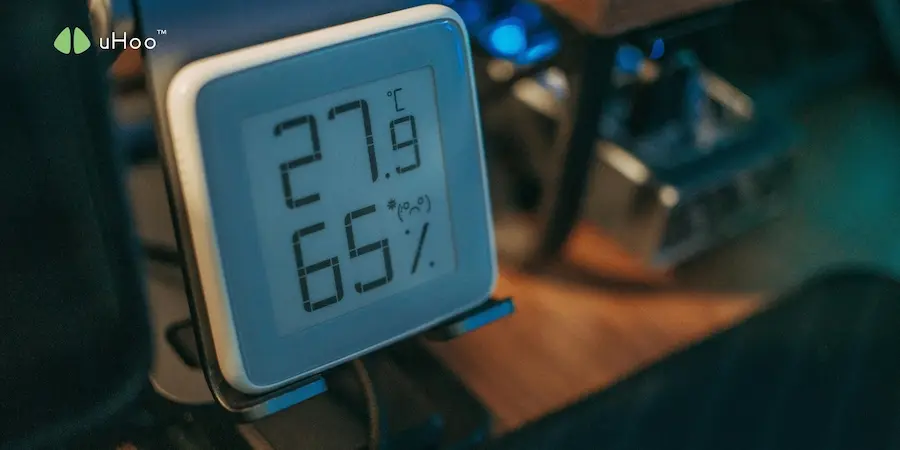
While IR thermometers give you the precise location of an immediate moisture problem, a smart air quality monitor, like uHoo, provides the necessary continuous environmental data. Your uHoo monitor tracks the overall humidity in your home. A sustained high humidity reading from uHoo (e.g., over 60%) warns you that the entire environment is ripe for mold. This general warning should prompt you to conduct a targeted, predictive scan with your IR thermometer to find the specific cold spot that is initiating the risk.
The final, most advanced layer of this proactive approach is the uHoo Mold Index. While IR thermometers are excellent for predicting a crisis by finding the precise moisture location, the uHoo Mold Index is a proprietary, real-time scoring system that uses the total environmental data from your monitor, humidity, temperature, and other factors, to predict your next air quality crisis on a systemic level.
It provides a simple, actionable score indicating the likelihood of mold proliferation, empowering you to adjust your ventilation or dehumidification before the hidden moisture found by your IR scan turns into an active, spore-releasing infestation.