
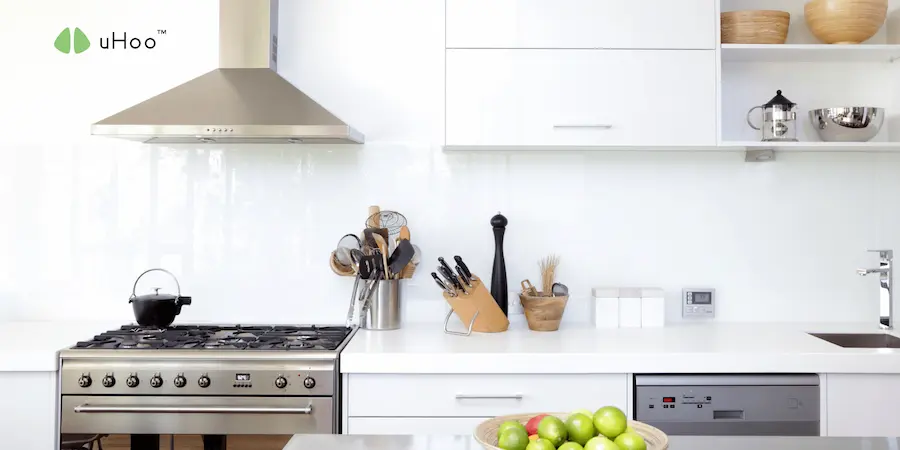
For the meticulous homeowner, every appliance should operate at peak efficiency. This is especially true for the range hood, whose ability to purify your air is directly linked to its installation.
Finding the perfect height to maximize your range hood’s power is not a trivial task. It is the most critical factor in transforming your kitchen’s ventilation from minimal effort to a true, pollutant-eliminating force.
The “power” of a range hood is not just its CFM rating. It’s its capture efficiency, the percentage of cooking exhaust that is actually pulled out of the house. This efficiency is highest when the hood is placed in a specific, narrow zone above the cooktop where the rising plume of heat and contaminants is most concentrated and easiest to capture.
This zone is defined by the physics of the cooking plume:
- The Cone of Concentration: As heat and fumes rise from the stove, they form an expanding cone. The closer the hood is to the base of this cone, the smaller the area the hood needs to cover and the higher the plume’s velocity is, making it easier to capture.
- The Point of No Return: If the hood is placed too high, the plume expands past the hood’s width, cools, and loses its upward momentum. The hood’s fan then has to work against the natural dispersal of the air, significantly reducing its effectiveness—the point of no return.
For most residential ranges, the perfect height is typically between 24 and 30 inches above the cooking surface. This range is a compromise that offers maximum capture efficiency while still providing sufficient headroom for comfortable cooking.
Installing the hood even a few inches outside of this range, particularly above the 30-inch mark, can result in a dramatic loss of the range hood’s power. [Image showing the cone of concentration and the optimal height range]
To truly confirm that you’ve found the perfect height to maximize your range hood’s power, you need more than just a tape measure. You need to measure the results. An air quality monitor can quantify the hood’s performance during actual use.
By monitoring the levels of fine particulate matter (PM2.5) while cooking, you can test if your hood installation is working. If you notice a high PM2.5 spike and a slow return to a clean air reading, you know the hood is underperforming.
A device like uHoo gives you this objective data. uHoo’s real-time pollution readings empower you to fine-tune your installation (within safe limits) or verify that your professional installer has achieved the perfect height, ensuring your hood is operating at its true potential and protecting your family’s air quality.