
The greatest challenge in addressing Sick Building Syndrome (SBS) is the invisibility of the pollutants that cause it. Occupants feel ill, often reporting headaches, fatigue, and persistent irritation, but the air appears clean, odorless, and harmless. Diagnosing and curing a sick building requires shining a light on these invisible threats: the gaseous and microscopic particulates that are trapped within the structure.
Diagnosis must begin with objective measurement, moving beyond anecdotal occupant reports to hard data. The air in a sick building is often a complex mixture of contaminants that fall into two main categories: chemical and biological.
Chemical pollutants primarily take the form of Volatile Organic Compounds (VOCs) and excessive carbon dioxide (CO2). VOCs are released from virtually everything new in a building, including flooring, wall coverings, printers, and cleaning supplies.
These compounds include formaldehyde, benzene, and toluene, and while individual exposure may be low, their collective, chronic presence acts as a powerful irritant to the mucous membranes and nervous system. Curing this often involves source removal (e.g., using low-VOC products) and drastically improving the ventilation to achieve a higher rate of air change.
Biological pollutants, conversely, are living organisms or their fragments. Mold, mildew, bacteria, and dust mite allergens flourish in high-humidity areas, stagnant drain pans, or water-damaged materials. These microscopic particles are aerosolized and inhaled, leading to allergic reactions, respiratory irritation, and sometimes even infections. Curing this requires fixing all moisture intrusion points and controlling the indoor relative humidity, ensuring it remains below 60 percent to prevent biological growth.
The key to a successful diagnosis is understanding the dynamics of these pollutants. For example, CO2 levels will rise and fall predictably with occupancy, signaling a failure of the ventilation system to keep pace. VOCs may spike immediately after cleaning or a renovation, then slowly decline. Biological issues often correlate with higher humidity or barometric pressure changes. Without continuous monitoring of these factors, remediation is a series of expensive, educated guesses.
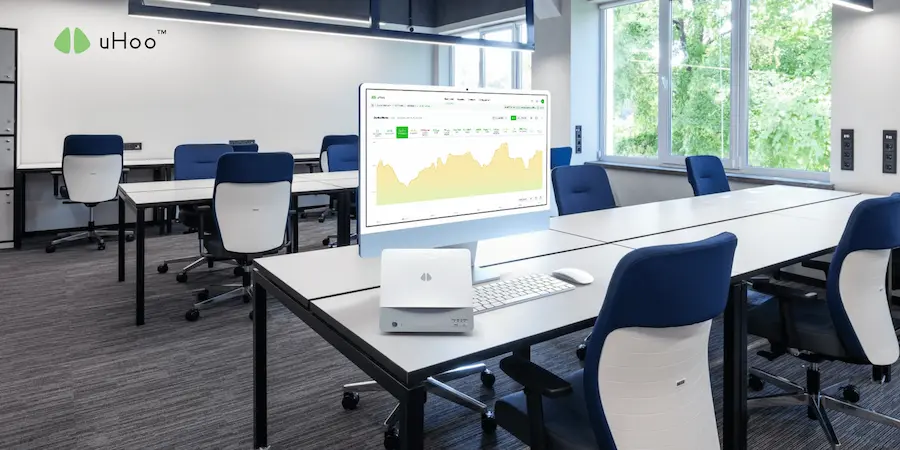
To effectively diagnose and cure a building’s air, technology must replace guesswork. The uHoo air quality monitor is a powerful diagnostic tool that makes the invisible pollutants visible. It operates non-stop, providing a holistic and detailed picture of the building’s environment.
By delivering an original, real-time breakdown of VOC, CO2, and other contaminant levels, uHoo allows building operators to pinpoint the exact time and location of pollution spikes. This data is the prescription for the cure, it identifies whether the problem is inadequate ventilation (high CO2), off-gassing materials (high VOCs), or hidden moisture issues, guiding targeted, effective repairs that truly cure the sick building.