
In an era of “smart” homes, our ability to control our environment has never been greater. We can adjust our thermostats from our phones, turn on lights with our voice, and even lock our doors remotely. But for a homeowner, one of the most critical aspects of a healthy home, the air, is often left to guesswork.
The clear choice for a healthy home is to implement a ventilation strategy that is guided by real-time data. Without this data, you’re flying blind, leaving your home vulnerable to a host of invisible pollutants.
The passive approach to ventilation is based on assumption. You assume the air is stale, so you open a window. You assume the air is clean after a shower, so you turn off the fan. This reactive approach is inefficient and often ineffective. A successful ventilation strategy needs to be proactive, and proactive strategies are built on data.
Here are a few key reasons why real-time data is essential for your home’s ventilation:
- Invisible Pollutants: Many of the most harmful indoor air pollutants are invisible and odorless. Carbon dioxide (CO2) builds up as you breathe, and a high level can cause drowsiness and headaches. Volatile Organic Compounds off-gas from furniture and cleaning products, and you can’t see them. Particulate matter (PM2.5) from cooking and candles is too small to see with the naked eye. Without real-time data from an air quality monitor, you have no way of knowing if these pollutants are present and at what levels.
- Outdoor Air Conditions: A successful ventilation strategy requires a knowledge of both indoor and outdoor air quality. Is it a high pollen day? Is there a lot of smog from traffic? A reactive strategy doesn’t account for these factors. A data-driven approach, however, uses an outdoor air quality index to advise you on the best time to ventilate.
- Efficiency: An effective ventilation strategy isn’t about constant air exchange; it’s about efficient air exchange. You want to bring in fresh air and remove pollutants only when necessary. This saves energy and prevents you from making the problem worse by bringing in outdoor pollution.
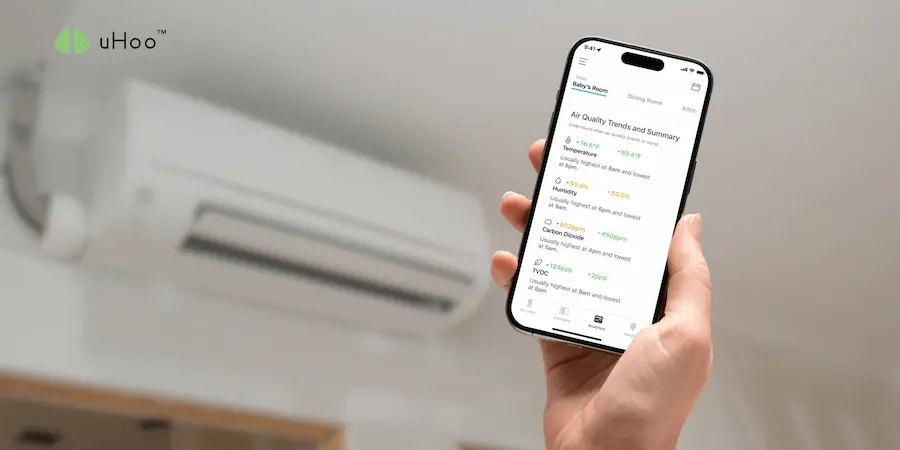
The uHoo air quality monitor is the clear choice for a data-driven ventilation strategy. It provides a comprehensive, real-time picture of your home’s air. It doesn’t just tell you that your air is “bad”. It tells you why it’s bad.
For example, it might show you a spike in PM2.5 after cooking, and advise you to use your kitchen vent more often. Or it might show you a rise in CO2, telling you it’s time to ventilate, and then tell you whether the outdoor air quality is good enough to do so.
The uHoo app provides clear, easy-to-understand recommendations, taking the guesswork out of a healthy home. In the end, a ventilation strategy without real-time data is a gamble. With uHoo, you’re not just guessing; you’re making a clear, informed choice for a healthier home.